

Recruiting Video for Social Media: The Edit Plan for LinkedIn, Instagram, and TikTok
A centered 9:16 crop from a 16:9 image discards 68.36 percent of the image width. Here's what that means for delivery formats, master resolution, and the shoot day, channel by channel.
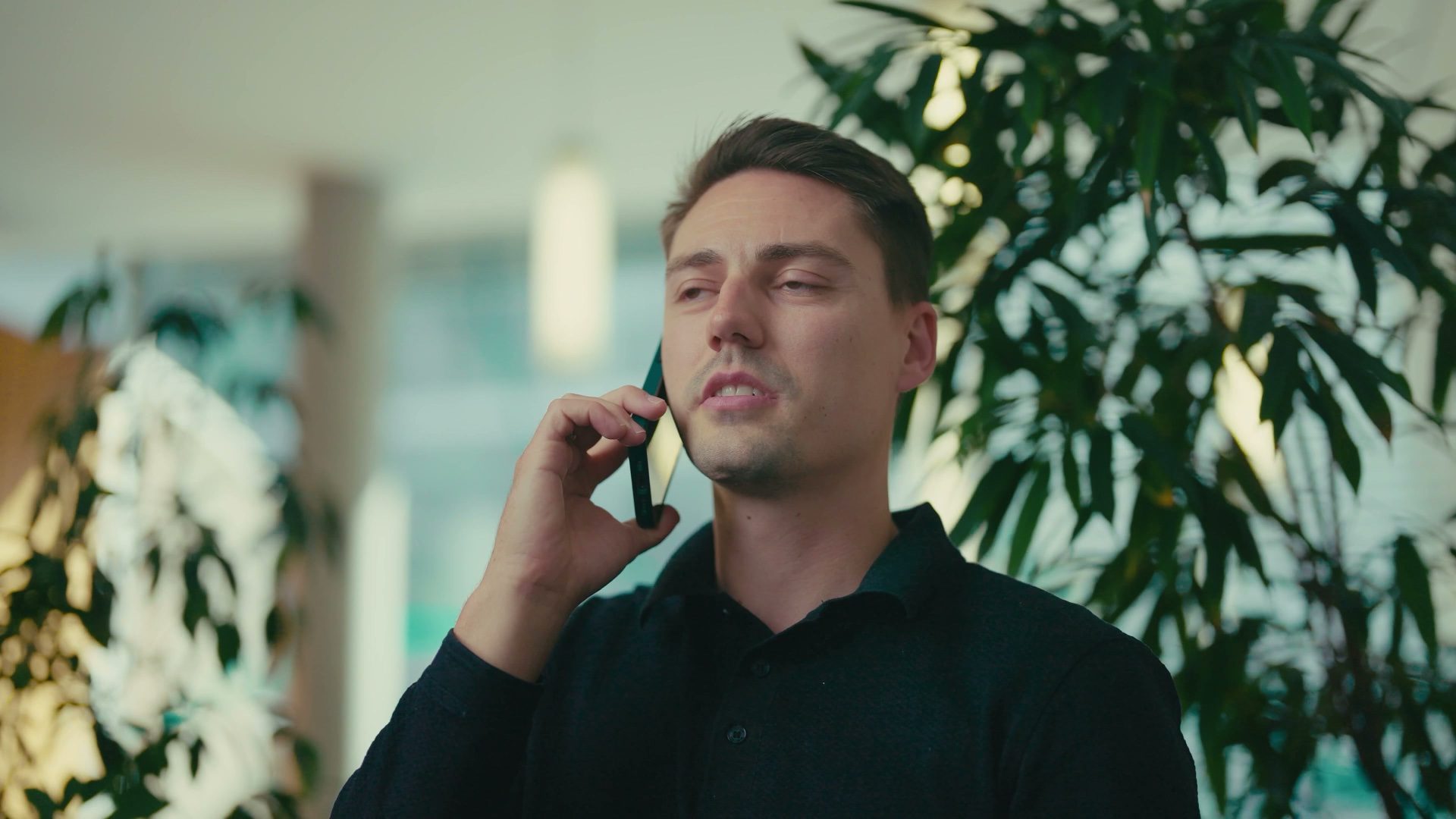
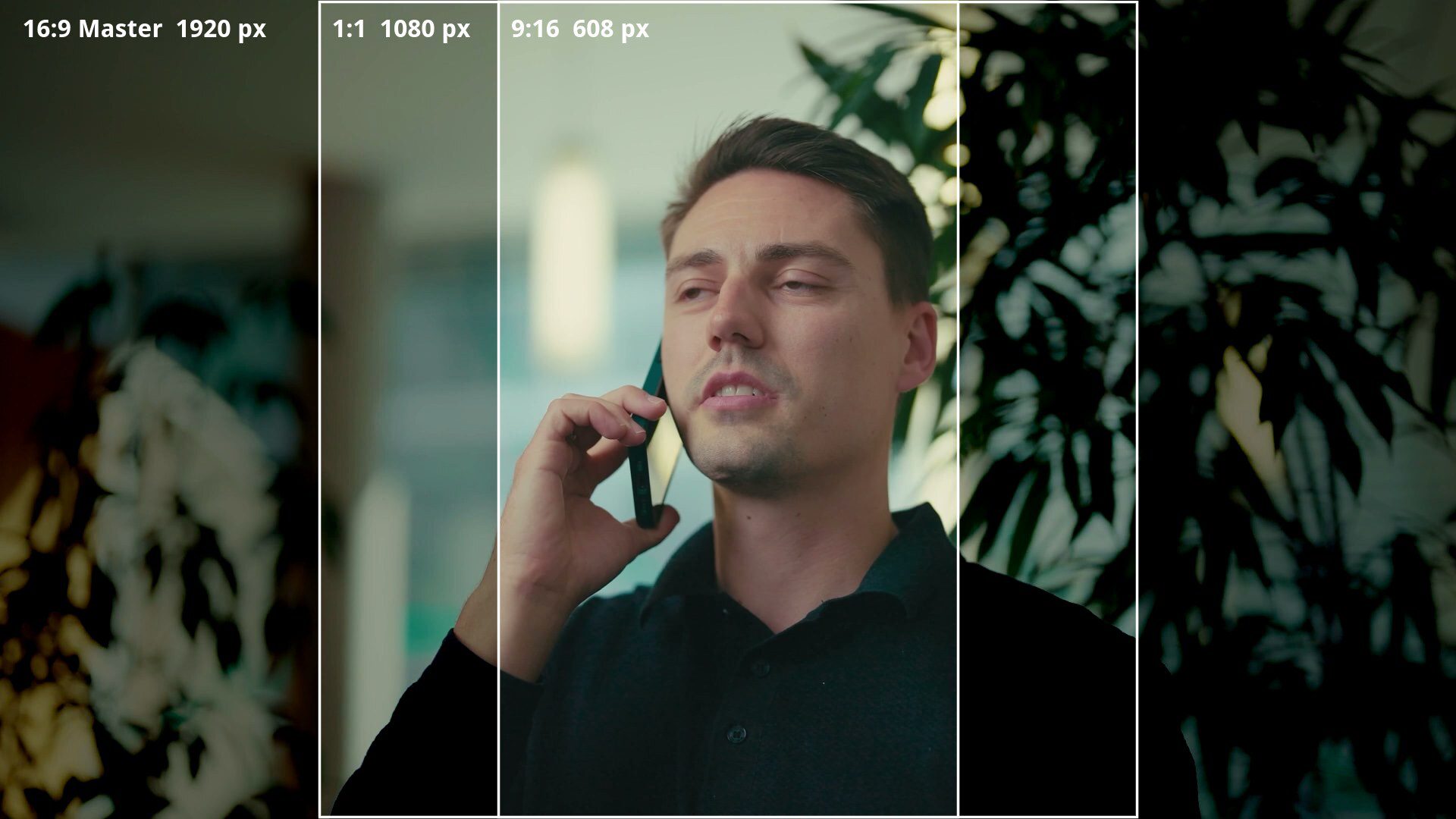
A centered 9:16 crop from a 16:9 image discards 68.36 percent of the image’s width. At full height, at any resolution, with any subject. Anyone who commissions a recruitment video for LinkedIn, Instagram, and TikTok is essentially ordering three different frame crops from a single shoot, and this one percent determines how the shots will be framed on the day of filming.
The other aspect ratios are hardly any better. A centered 4:5 crop loses 55.00 percent of the width, while a 1:1 crop loses 43.75 percent. Two colleagues who are standing on the left and right sides of the frame in the 16:9 master are both cut out of the 9:16 edit.
On a cell phone, the math is reversed. A Samsung Galaxy S24 has a resolution of 2340 x 1080 pixels, exactly 19.5:9, while an iPhone 16 has a resolution of 2556 x 1179. At full width, a 16:9 video fills about 26 percent of the screen height, while a 9:16 video fills about 82 percent.
What formats should a recruitment video have for social media?
Each channel has its own rules regarding aspect ratio, length, and subtitles. This list should be included in the briefing before the shooting schedule is finalized, not after.
| Channel | Aspect ratio | Length | What the Editor Needs to Keep in Mind |
|---|---|---|---|
| LinkedIn Feed, Organic | 1:2.4 to 2.4:1 allowed; in practice, 4:5 or 1:1 | 3 seconds to 15 minutes | Starts playing without sound. Automatic subtitles are enabled only if the switch is set during upload. |
| LinkedIn Video Ads | 1:1, 4:5, 9:16, or 16:9 | 15 to 30 seconds recommended | Exactly one SRT file per video, attached before publishing |
| Instagram Reels | 9:16 Recommended | Over 3 minutes: No recommendation to non-followers | Safe Zone for Ads: top 14 %, bottom 35 %, sides 6 % each |
| TikTok In-Feed | 9:16, at least 540 x 960 px | App recording up to 10 minutes | No fixed safe zone values; TikTok provides a template and preview |
| YouTube Shorts | square or portrait orientation | up to 3 minutes, since October 15, 2024 | 16:9 doesn't count as a short |
| YouTube, Feature Film | 16:9 | free | Chapter starting with three timestamps, the first at 00:00 |
| Career page | 16:9 | free | VideoObject markup with name, thumbnailUrl, and uploadDate |
What is ultimately delivered can be outlined using a project as an example. For Kenvue In Neuss in 2026, we filmed three employee profiles, one per department: Jan, Key Account Manager, 30 seconds; Hannah, Senior Brand Manager, 33 seconds; Elke, Brand & Shopper Activation Director, 25 seconds. All master and social media formats were delivered in 9:16, 16:9, and 1:1 aspect ratios for the rollout in EMEA.
Here’s the basic structure: one master video per film, plus the derivatives for the channels where you’ll actually post them. Kenvue provided the brand, values, and guidelines for the script. We came up with the story and visual style, edited to the three participants’ own voiceovers, without an interview setting.
Other packages are smaller in scope. Two films for the BMAS were delivered as a 16:9 main film plus a 4:5 social teaser; an Ostrom testimonial was delivered as cutdowns in 4:5 and 9:16, plus a subtitled version. GLX was commissioned to handle editing, color grading, voice-over recording, and social media cutdowns for a 30-second spot produced during a single day of filming at the ongoing camp.
What resolution should a recruitment video be shot in?
The resolution of the master file determines whether the 9:16 aspect ratio can be achieved without upscaling. The calculation is purely geometric and can be written down in advance.
| Target Format | Loss of image width | from a Full HD master at 1920 x 1080 | from a 3840 x 2160 UHD master |
|---|---|---|---|
| 9:16 | 68,36 % | 607 px, not enough for 1080 x 1920 | 1215 px, that's enough |
| 4:5 | 55,00 % | 864 px, not enough for 1080 x 1350 | 1728 px, that's enough |
| 1:1 | 43,75 % | 1080 px, that's exactly enough | 2160 px, that's enough |
After cropping a Full HD master to a centered 9:16 aspect ratio, 607.5 pixels in width remain. For delivery at 1080 x 1920, this is only sufficient with upscaling. From a UHD master, 1,215 pixels remain, and that’s enough. The only aspect ratio that can be derived from Full HD without any scaling is 1:1, with exactly 1,080 x 1,080.
If you shoot in portrait orientation, the calculations are reversed: from 2160 x 3840, 1215 pixels remain for the 16:9 crop, while from 1080 x 1920, only 607.5 remain. DaVinci Resolve 20.1 has added a mode dropdown to Smart Reframe—with options for Auto, Pan Only, and Tilt Only—that can salvage a take in which the subject walks out of the center of the frame.
Recruiting Videos on LinkedIn: Format, Length, and Captions
LinkedIn accepts any aspect ratio between 1:2.4 and 2.4:1 in the organic feed. This is a continuum, not a list of four formats. An organic post can be up to 15 minutes long, with a minimum duration of 3 seconds on desktop and 2 seconds on the mobile app.
Video ads are a separate product with their own rules. They accept exactly four aspect ratios: 1:1, 4:5, 9:16, and 16:9. LinkedIn recommends 15 to 30 seconds for an ad to qualify for placement in the feed and on the Audience Network; Jan’s 30-second ad and Elke’s 25-second ad fit within this range, while Hannah’s 33-second ad is just over the limit.
Feed videos start playing without sound when you scroll, both on the web and in the app. Automatic captions are available in 10 languages, including German, but only if you toggle the switch during upload; it’s turned off by default. For standard closed captions, LinkedIn requires exactly one SRT file per video, which must be attached via the desktop interface before publishing.
LinkedIn identifies three signal groups that influence content distribution in the feed: Identity, Content, and Activity. Video format does not appear as a separate factor in this list, nor do external links. On LinkedIn, the choice between 16:9 and 9:16 is a matter of screen real estate.
Recruiting Video for Instagram Reels and TikTok: 9:16 and Safe Zone
Instagram is the most widely used social media platform in Germany, with 40 percent weekly usage according to the 2025 ARD/ZDF Media Study, ahead of Facebook at 31 percent and TikTok at 20 percent. The feed supports six aspect ratios: 1.91:1, 16:9, 1:1, 4:5, 2:3, and 9:16; Instagram recommends 9:16 for video. Reels can be recorded and edited up to 20 minutes long, but anything longer than 3 minutes is no longer recommended to non-followers.
For Reels Ads, Meta requires a clear area: 14 percent at the top, 35 percent at the bottom, and 6 percent on each side, free of text, logos, or other important design elements. If the ad includes a disclaimer, the bottom 40 percent must remain clear. Captions with a name and job title should therefore be placed in the center of the image.
TikTok does not specify a fixed safe zone in pixels or percentages. There is a template file available for download and a preview tool, and TikTok itself states that the safe zone shifts depending on caption length, interactive elements, text direction, and playback stage. Anyone who gives you fixed pixel values for TikTok is likely using a template from an agency.
The lengths depend on how the video was recorded. A TikTok video recorded in the app can be up to 10 minutes long, while one uploaded from the gallery can be up to 60 minutes long; the 10-minute limit has been in effect since February 28, 2022; previously, it was 3 minutes. For in-feed ads without Spark, TikTok recommends a 9:16 aspect ratio with a minimum resolution of 540 x 960 pixels.
Recruiting video on YouTube, the careers page, and in the job posting
YouTube reaches 72 percent of Germans aged 14 and older, and 16:9 is the standard aspect ratio on computers there. A “Short” only counts if the video is square or portrait-oriented; anything wider, including 16:9, plays as a regular video. As of October 15, 2024, a Short can be up to three minutes long.
Google reports, based on its own internal data from 2024, that a vertical video in an ad group that previously consisted solely of horizontal videos increases the view-through rate for Shorts by more than 40 percent. This figure comes from Google itself, and the methodology has not been disclosed.
The job posting itself remains text-based. Indeed’s quality standards and rules for employers do not include any technical specifications for video; the Federal Employment Agency’s JOBBÖRSE platform only provides text fields when creating a posting; and LinkedIn’s help page for posting a job mentions neither video uploads nor video links. The video is hosted on the careers page and in the feeds; the job posting links to it.
Google's rules for video rich results apply to the careers page. The VideoObject markup requires exactly three properties—name, thumbnailUrl, and uploadDate—and Google requires that the video be hosted on a dedicated page whose primary purpose is that single video. A `video` element with the `autoplay` attribute loads immediately, even outside the visible area; the poster image or the first rendered frame counts as a candidate for Largest Contentful Paint.
Why Every Social Cut Needs Subtitles
An online survey of 5,616 U.S. adults aged 18 to 54, conducted for Verizon Media and Publicis Media in 2019, found that 92 percent watch mobile video at least some of the time without sound. 69 percent do so intentionally in public, and 25 percent do so at home as well.
The often-cited figure of 85 percent of Facebook videos watched with the sound off comes from a Digiday article dated May 17, 2016. The figure was based on self-reported data from two publishers, with no methodology, no sample, and no measurement period; PopSugar cited a range of 50 to 80 percent in the same article. The 92 percent from the survey is the more reliable figure.

For the Berlin Job Center We therefore created twelve portraits—one for each job center—plus an overarching film structured as a series. The footage runs as a calm, silent visual layer; the people speak separately from it, recorded in a private space. Each portrait is short enough for social media and personal enough to be impactful.
Captions belong in every social media clip. Facebook cited an average viewing time that was 12 percent longer for video ads with captions on its own business blog; Adweek reported the same figure on February 10, 2016. Subtitles for recorded media also meet WCAG 2.1 Success Criterion 1.2.2, Conformity Level A.
What changes on the shoot day when three formats go out
On set, three formats from a single take are referred to as: framing for the tightest shot, and the 9:16 strip in the center. The ARRI ALEXA 35 records in 4.6K 3:2 Open Gate at 4608 x 3164 photosites and displays up to three framelines—A, B, and C simultaneously in the viewfinder, on the monitor, and on the SDI outputs, plus two freely configurable rectangles for the protected image area.
The Sony FX30 offers 15 selectable aspect ratio markers, including 9:16, 4:5, and 1:1. They appear only as an overlay on the monitor; they are neither outputted nor burned into the footage. This means that the assistant director can see the lines on set, but the editor cannot see them later.

The three Kenvue films were shot in a single day, entirely on a gimbal, using a Sony FX6 and fast prime lenses at wide apertures. They were graded to achieve a cinematic Kodak look.
How much does an additional format cost?
Some videos only need one aspect ratio. If you’re only posting on LinkedIn and using a 16:9 aspect ratio there, don’t order a 9:16 video; every additional cut takes time to edit, and a vertical video that no one posts will just end up in the archives. For a single Story post from the HR department, your cell phone is all you need.
The price difference rarely arises on the day of filming, but rather during post-production. A second day of filming costs many times more than an additional edit, which is why finalizing the channel list before filming is the most cost-effective decision in the entire project. The contents of each package are clearly listed on our page about the Recruitment Film Cost.
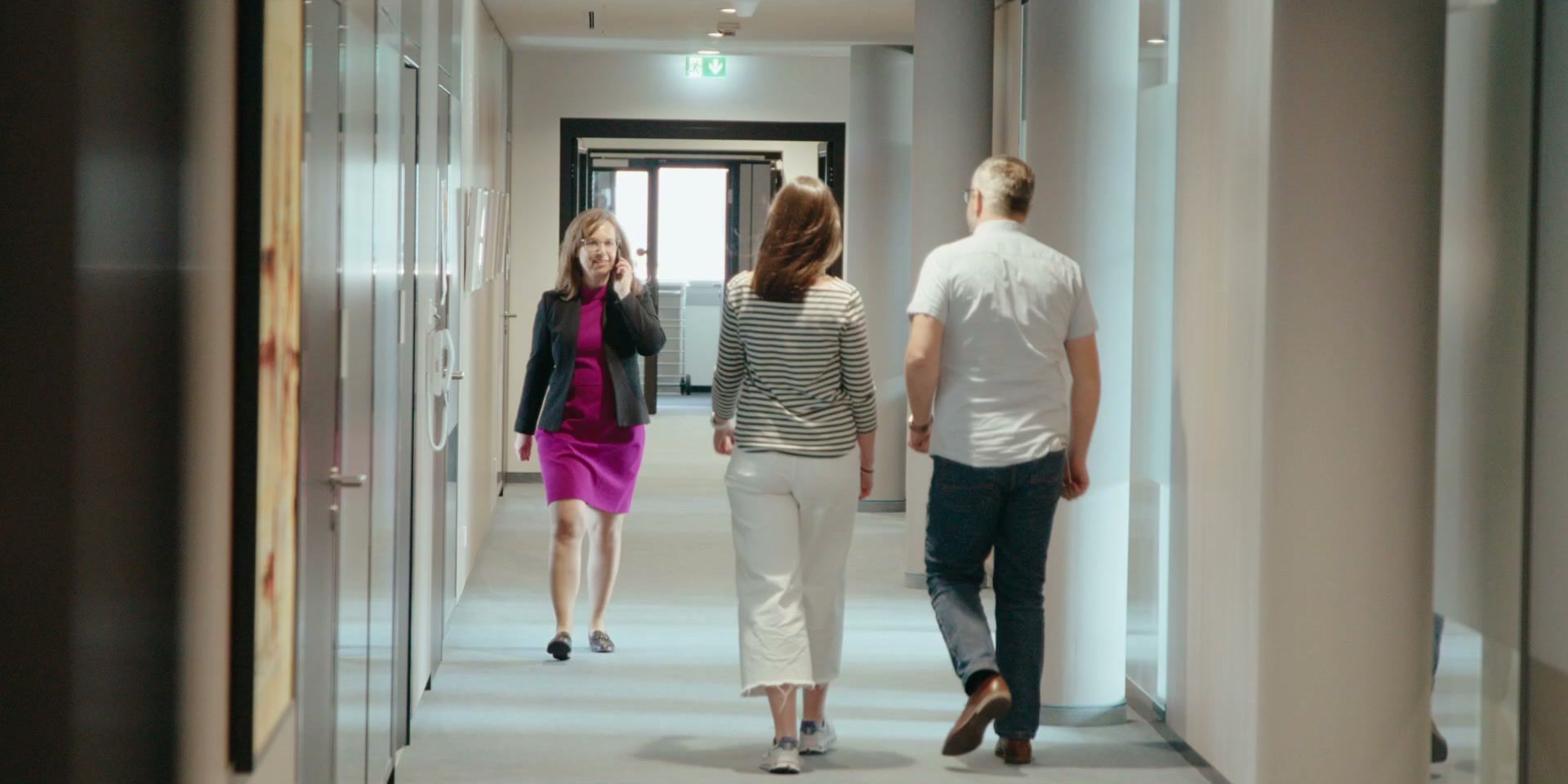
Larger projects take more days. At Allianz’s Logistics Service Center on the Berlin Campus—which handles about 540 people and over 140,000 transactions a day—two days of filming yielded a whole package of footage. The format list had been determined in advance, and the framing guidelines were already set in the viewfinder on the first morning.
Before a Recruitment Film Production That's why we'll work with you to finalize the channel list before the shooting schedule is set. For GLX Here's what that entailed: one day of filming at the warehouse, six employees in front of the camera, a 30-second spot plus social media clips for eight German locations with about 250 employees. The campaign launched in March and generated 400 applications in three months.